
We’re here to bust some bubbles regarding water damage. If you think the flood is over, the water is gone and running up your fans on full speed should have you covered, you might want to rethink your entire situation.
Most homeowners fail to understand that visible water is just the tip of the iceberg, and in fact, not even a real problem. What comes next, within 24 to 48 hours, is what really wreaks havoc in your home.
We don’t mean to scare you, but we need to make sure you understand exactly what’s happening inside your walls and under your floors if water damage restoration isn’t your first instinct.
What Happens in 24 to 48 Hours?
The first thing that begins to happen after water damage are mold spores. Water damage provides the moisture, and when conditions are right, these dormant spores begin the germination process within 24 to 48 hours.
The main factors behind these mold spores are:
- Moisture is the primary trigger behind mold. Mold requires material moisture content above approximately 19–20% (for wood) or water activity above 0.7 for most species.
- Mold thrives in warm temperatures, roughly between 60°F and 80°F.
- Since wood frames and drywalls are made of organic material, mold feeds off them.
What Happens Every Hour?
Within the first hour mold spores make contact with the wet surfaces. You won’t see a visible effect yet, but the biological process of spore germination begins when moisture conditions are favorable.
After about 12 to 24 hours, hyphal growth will begin. These are microscopic filaments that form the structural body of mold colonies start extending into porous materials. Still invisible to the naked eye, but the organism is establishing itself within the material, not just on its surface.
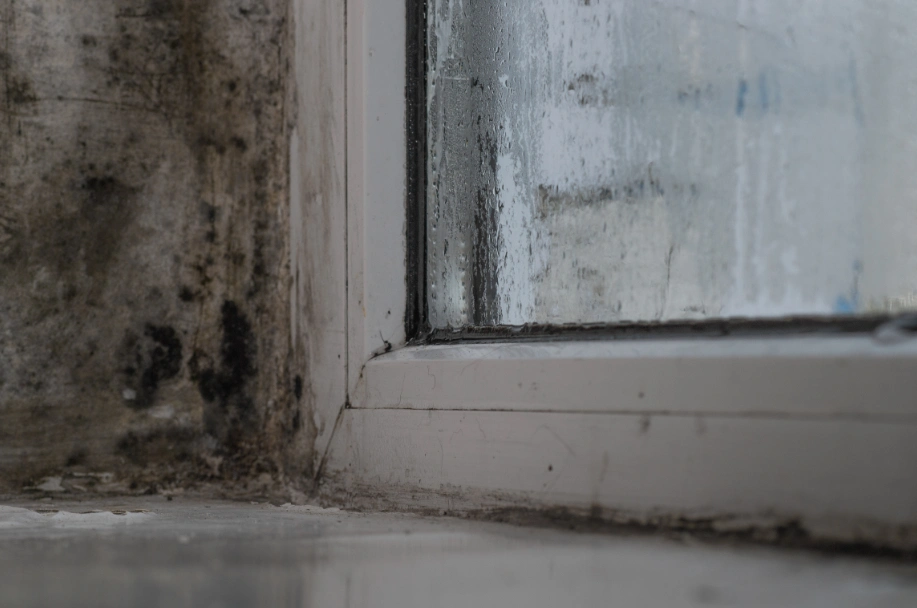
In 48 hours, you’ll be able to see the spores under a magnifying glass. If you wait 72 hours or even a week, you’ll start seeing colonies. These will appear as dark spots, fuzzy growth or discoloration. By this point, the organism has already embedded itself into the material, not just grown on the surface, and surface cleaning is insufficient.
If you don’t intervene in one to four weeks, you’ll see the mold begin to spread. At this point, the scope of mold remediation has seriously grown.
What Types of Molds Show Up After Water Damage?
Cladosporium
This is the most common type of mold. It grows on both warm and cold surfaces, spreads readily on drywall and wood, and is one of the earliest mold after a flood. It typically appears as a dark green or black spotting.
Aspergillus
This is a large family of mold. Some species produce mycotoxins, which are chemical compounds that can cause health effects with chronic exposure.
Penicillium
Penicillium grows rapidly on surfaces such as carpet, drywall, and insulation. It also spreads quickly due to its high spore production, has a blue-green and powdery appearance and can cause respiratory irritation even in otherwise healthy individuals.
Stachybotrys Chartarum
Stachybotrys chartarum, or otherwise known as black mold, takes longer than 24 to 48 hours to establish itself. It has more serious health concerns than the faster-growing, early-colonizing species.
Also Read: Step-by-Step Mold Remediation Process for Homes
What Does Fast Response Actually Look Like?
The 24 to 48-hour window is a helpful boundary between a water damage response that intercepts mold growth and one that’s simply managing mold contamination.
Professional water damage restoration within that window involves more than extracting standing water and setting fans. The IICRC S500 Standard for Professional Water Damage Restoration outlines water extraction, moisture mapping using calibrated meters across all affected materials, targeted drying using industrial dehumidifiers and air movers positioned based on moisture readings, temperature management to optimize drying rates, and documentation throughout.
The most important step is moisture mapping. Materials can appear dry on the surface while retaining dangerous moisture levels internally. Without instrument verification, you don’t actually know when drying is complete.
When Is Mold Remediation Necessary?
If, for any reason, you’ve overlooked the situation for 24 to 48 hours, you’ll need to resort to mold remediation.
The EPA’s guidance for mold remediation states that small areas may be addressable by an informed homeowner with appropriate protective equipment; larger areas, however, require professional remediation.
Professional mold remediation involves containment, HEPA air filtration, removal of contaminated materials, treatment of non-porous surfaces, and post-remediation testing to confirm successful removal.
Dealing With Water Damage?
If you’re dealing, or more correctly, struggling with water damage, the Flood Restoration Pros can help! We respond fast, work to the IICRC standard and have services that are built around the reality of these timelines: the sooner the call, the more manageable the outcome.
Waiting to see if it dries out on its own might be the worst mistake you make! Call us and let professionals with the right equipment assess the situation before the clock runs out.
